Thursday, June 27, 2013

Some summer events, three unique cinema experiences + two noteworthy, unpretentious restos in Manhattan

Anat Cohen
Large & small festivals of all sorts seem to proliferate throughout New York City during the summer months. As we are all, by now, well aware, there are theater, music, film, food, wine & beer, and street festivals of every ilk:  there is, among hundreds of such summer-long events, the "River-to River, 2013" festival featuring numbers of performing artists, including the Lar Lubovitch Dance Company (scheduled for June 25th @ 7:30 at the Schimmel Center for the Arts; 3 Spruce Street, downtown, in the heart of Pace University); or the Madison Square Park Conservancy / Music 2013 Oval Lawn Series (featuring the likes of Suzanne Vega, Ben Sollee, & the Anat Cohen Quartet this week, June 26th @ 7:00; located between Madison & Fifth @ 23rd/24th Streets); AND a 3-week long 50th Anniversary Ozu film festival at the Film Forum (June 7th-27th; 209 West Houston St; 212/727-8110) commemorating the work of Yasujiro Ozu (1903-1963). 
 Yasujiro Ozu

The festival couples both his well-known masterpieces -The Flavor of Green Tea Over Rice, Tokyo Story,The End of Summer, Late Autumn - with lesser known films (too numerous to list in full), such as one we were able to catch entitled Equinox Flower (1958), Ozu's first color feature, superbly, carefully, sensitively acted but with a light "footprint," focusing on all aspects of marriage & the family - from traditional & arranged marriages, to the rigors of a daughter(s) choosing her own husband & a stern father's having to get used to new, non-traditional ways. Ultimately, according to one reviewer, the film presents "a balanced picture of Japanese family life, made with loving irony." (Don't know if this charming film is currently available from Netflix.) 
 
Edward Hopper work
One other special (somewhat "summer") event  which should be noted - especially by those living in the Montclair, NJ area, or with easy access to Essex County - concerns a creatively arranged & mounted show entitled The New Spirit: American Art in the Armory Show, 1913. The show ran from February 17th thru June 16th (it has, obviously, just ended). 

Mary Cassatt work
According to Montclair Art Museum publicity material, the "exhibition [which opened 100 years to the day from the original New York City Armory Show] focuses on the diverse range of American art, that was exhibited alongside modern European art by Cezanne and Matisse." Included, for example, were works of Mary Cassatt, Edward Hopper (Sailing, 1911), and Oscar Bluemner (Hackensack River, c. 1912). The show was, indeed, a stunning, circumscribed representation of American art earlier displayed at the NY City Armory Show in 1913, providing a fine opportunity for local museum-goers to witness some truly wonderful works in various media (along with some original documents & memorabilia), all assembled tastefully in a few well lighted rooms for relative ease of viewing.

Three new, or recent, films to take note of and that I must recommend to you - without pyrotechnic activity & artificial mayhem - consist in the following: Renoir (2012, directed by Gilles Bourdos); Plimpton (2013, a documentary directed by Tom Bean & Luke Poling); and A Highjacking (2012, a feature film directed by Tobias Lindholm). To even mention these three currently running films is to speak of three strikingly different & original kinds of cinema experiences. 

Renoir is composed of lush scenes & richly colorful vistas to be discovered by the viewer and dwelt upon - "painted" by both Pierre-Auguste Renoir (imperially & imperiously played by Michel Bouquet) and, also, by the film's cinematographer (Mark Lee Ping Bin) ... and set primarily at Renoir's estate in the south of France along the Cote d'Azur. The film focuses on the diurnal life of the working artist struggling in old age with constant, terrific, arthritic pain (his brushes must be strapped to his grizzled hands and fingers so that he can hold them, sketch & paint). This impressionist film, then, is centrally a portrait of an individual - a great impressionist painter - who cannot live without painting and without his current young model & bevy of loyal older models ... and who must endure the pain (both physical & emotional) as he must go on creating during the period of World War I. 

P-A Renoir (Michel Bouquet)
Renoir is also the story of a war-wounded Jean Renoir convalescing on his father's estate and the affair he has with his father's most interesting, youthful, recalcitrant & sensual model, Andrée Heuschling, as he recovers from his leg injury, develops as a man (a thoughtful man) and begins to refine his interest & skills in the art of film. This is a fabulously colorful, sensuous film to view, seemingly "painted" on a broad canvas & finely textured, a film displaying superbly natural acting by all the cast members, en ensemble, a film that is sincere & powerful, deep & natural, and somewhat enigmatic, at times, in its portraits of Jean and his beguiling, difficult, even truculent father, Pierre-Auguste, "le patron."

Plimpton is a black-and-white, feature-length documentary film about the celebrated writer-editor-journalist, himself, George Plimpton. With Plimpton at center stage, the film essentially explores how he involved himself in all kinds of what he calls "participatory" journalistic activities. The film is, for the most part, narrated by Plimpton ... reflecting Plimpton writ large over 3 or 4 decades. And the material is presented throughout in Plimpton's own voice along with a few talking heads, such as Plimpton's good friend, the writer Peter Matthiessen, who invited him to Paris in 1953 to help begin what would become - under Plimpton's diligent editorship -.The Paris Review, one of the most elegant literary magazines in the entire canon of "small" magazines, in America & abroad. 

Plimpton / Quarterback
Indeed, Plimpton, defining & emphasizing his amateur role as a sports figure (though certainly identifying himself as a professional writer) ended up in some very difficult, even precarious, situations - playing a goalie for the Boston Bruins professional hockey team; a 9th-string quarterback for the Detroit Lions; a baseball pitcher pitching to the likes of Willie Mays; a trapeze artist (with a net), very high above the circus crowd swinging and being caught by the legs; boxing (sparring) with the famous champion, Archie Moore; acting alongside John Wayne; taming lions; and playing the triangle & bass drum in the percussion section of the New York Philharmonic. Plimpton is depicted throughout the film participating in all of these difficult professional activities - seemingly sans fear, as an amateur - and ends up writing several books about these stunts (including Paper Lion:  Confessions of a Last-String Quarterback; 1966) and his relatively consistent desire to participate

You can't help but get to know George Plimpton, his ticks, his failings, his strengths at managing a major literary magazine, managing writers, and motivating people - both readers & writers and the athletes with whom his activities coincided. It seems that Plimpton, who died in 2003 at 76, is a literary figure very much missed ... but still, really, very much present & very much on the literary scene!

In summing up this documentary film, I offer you what Plimpton has articulated about himself and his work, in his own words "Well, I have to write. A lot of people forget that. They think I'm some sort of a crazy buffoon who can't quite make up putting his mind [at] what he wants to do in life. But it's not that at all. It's, I'm a professional writer and have this device, really, of trying other people's professions." And so he did ... many times, over many years.

Based on an actual 2007 incident in the Indian Ocean involving the Danish cargo vessel, the MV Rosen, Tobias Lindholm's A Hijacking is the incredibly tension-laden, taut, nerve-wracking story of the actual event, a precarious highjacking situation which lasted some four (+) months.  The film examines the bleak events sparely, in almost cinema verite style, from the point of view of the ship's crew (notably the ship's cook, the captain & a mate); the corporate "chief" who negotiates with the Somali pirates that have taken over the ship; and the pirates' enigmatic representative, Omar.  

Scene from A Hijacking / Pilou Asbaek (Cook)
While we don't actually witness the pirates boarding & taking over the ship, we see all of the results: the pirate negotiator continually passing on the hijacker demands (via phone & fax) for millions of dollars in exchange for the safe return of the ship & the crew; the disheartened, edgy & physically diminished crew (seen primarily through the person of the cook who serves as symbolic stand-in for the crew of seven men); the corporate CEO who, choosing to negotiate himself (without this kind of experience) also becomes a prisoner of the hijacking, growing increasingly nervous, sleepless, ragged; the primitive trigger-clinging pirates, ready to pounce on the members of the crew for almost any reason.

To wrap up for the moment, it should be noted that events developing throughout the hijacking - and the prolonged negotiation with the pirates - are depicted in real time with  incredible tension mounting steadily on both the hijacked vessel and in the equally "hijacked" company's corporate conference room. Negotiations do, indeed, move forward, slowly, during what becomes - and we witness as - a fractured & shattering process:  A fast-paced western European corporate culture slowed down to a proverbial crawl in its negotiations (in its "battle") with the all-the-time-in-the-world and nothing-to-lose culture of the Somali pirates. You'll just have to see it all for yourself to determine who, or what, actually wins out - or loses - in the end.

Two West Village restaurants you might want to know about are Mercadito, an exceptionally friendly & unique Mexican resto ("taqueria & cevicheria"), and Pinto, offering up somewhat idiosyncratic but quintessentially tasty Thai-Asian cuisine at very (very!) inviting prices. 

Mercadito - Grove Street
Mercadito (100 7th Ave. South @ Grove Street; tel. 212/647-0830; with another location in the East Village at 179 Ave. B, between 11th & 12th) features, among other possibilities, an array of interesting Margaritas, guacamoles (plural!), ceviches, soft tacos, & large plates (platos fuertes).  But we chose to visit Mercadito because of their announced "regional dinners" served on two nights each month. For these evening events, organized & executed by Executive Chef Aldo Ayala, a special 4-course menu for $25 ($30, if you add beer, wine, or a cocktail) becomes available and ours - during mid-June (the 12th & 13th) - emphasized a menu of Mexican Grilling. What follows is what the chef plated & what we each dined on:

Taco de pescado
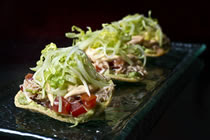
We began with crudo de callo de hacha, grilled diver scallops, with watermelon & pickled red onion, in a key-lime habanero broth. Very tender, very tasty; spicy & flavorful! Next came the taco de pescado plate, tacos filled with adobo marinated grilled red snapper, along with sides of apple-jicama slaw & tomatillo salsa ... an interesting mixture of tastes, aroma ... piquant & tender. The main course - carne a la parrilla - was, in short order, placed before us.  The entree comprised a large slice of rib eye steak, grilled to (near) perfection ... prepared with rosemary butter, and enhanced with charred scallions, cactus salad & a side of grilled corn. Simply overflowing, this well integrated plate, with nicely prepared "veggie" accompaniments, surrounding the rosemary butter "daubed" steak, worked well, although it proved a bit too large for my wife to finish. Our dessert - fruta de temporada - while maintaining the regional ("grilled") theme, was slightly disappointing. Anticipating something sweet and, perhaps, creamy, the fruit salad proved singularly tart & spicy. Some kind of "chocolaty," mousse-like, item might have proved a better finale to an otherwise successful meal. Nevertheless, we will, indeed, return to Mercadito to sample another regional, "Taste of Mexico," 4-course menu!

Pinto (at 118 Christopher St., west of Bleecker; tel. 212/366-5455) is, as I alluded to above, an inviting Thai-Asian "bistro" we selected for its eclectic, interesting & varied menus. They serve an $8 prix fixe lunch (an appetizer & a main) and dinner; they also offer a "Sunset Menu" at $15, between 3:30 & 6:00, which includes an appetizer, a substantial main dish & a drink (e.g., a variety of iced teas, Asian beers, house wines). Lots of possibilities in each category to choose from: For appetizers we chose the mushroom crunch (sesame-crusted mushroom served with jalapeno tartar sauce) & the grilled beef salad (succulent slices of beef with spicy tomato vinaigrette). 

PCU noodle dish
We followed up with a delicious, moderately spicy pork PCU noodle dish (rice noodles sauteed with sweet dark soy sauce, baby bokchoy & egg) AND a spicy (& complexly varied) bowl of tom yam fried rice with shrimp (jasmine rice wok-tossed with lemongrass & mixed with lime, fresh pepper-chili paste, mushroom, bell peppers & enoki mushroom). Our "sunset" meal was accompanied by a couple of Asian beers - Singha & Sapporo - both of which tended to temper & complement  the relatively piquant food we sampled.

Food here at Pinto is very fresh and the service is extremely pleasant & accommodating; portions are commodious & prices are, well, utterly reasonable. This spot could easily become our fall-back West Village Thai-Asian resto. Give Pinto a try; it might continue to kindle your interest, too!

Tuesday, May 28, 2013

Chick Corea, Chom Chom, an 8-gallery spectacle at The Met & more ...

This past weekend (May 17th-18th) Jazz at Lincoln Center mounted a fete to NEA Jazz Master & 16-time Grammy award winner, Mr. Chick Corea. And well they should, as, according to one spot-on (anonymous) source, Chick Corea has attained "living legend status after four decades of unparalleled creativity and an artistic output that is simply staggering."

Friends of Chick Corea
And, what's more, Jazz at Lincoln Center seems to have devoted all of its resources (and two of its venues) to celebrating the inimitable Chick, in his capacity of composer, musician (pianist), and, well, "friend."  We were, in fact, on hand for the Saturday show (the 2nd, 9:30, show) at The Allen Room (a truly magical venue overlooking Columbus Circle) for the tribute entitled "Friends of Chick Corea: Musicians of the Future."

The concert featured two outstanding young jazz pianists - Beka Gochiashvilli (from Tbilisi, Georgia) & Gadi Lehavi (from Tel Aviv), both friends & proteges of Mr. Corea - as well as Ravi Coltrane (tenor sax), Wallace Roney (trumpet; & Miles Davis mentee), John Patitucci (bass) & Marcus Gilmore (on drums). A varied assortment of Chick's music was on display at this event, including a newly orchestrated selection from his "Three Quartets" album (1997).

Chick on Drums!
But, most memorable - and a true highlight of the  evening - was an appearance by Mr. Corea himself (having just concluded a set in the Rose Theater across the hall, with Wynton Marsalis & the Jazz at Lincoln Center Orchestra) ... jumping around the Allen Room stage, bubbling with his inimitable energy, and enthusiastically promoting great good will among the attendant musicians & members of the concert audience amassed before him.

Seems everyone just had a grand time celebrating the musical "life" & work of this treasured virtuosic pianist-composer, and his decades long presence in & impact on the international jazz scene!

Chom Chom

Just prior to meandering a few blocks over to this Jazz at Lincoln Center event, we (two couples) took some time out for an opportunity to dine at Chom Chom (at 40 W. 56th, between 5th& 6th; tel. 212/213-2299), which offers what they (self-) identify as "modern" Korean cuisine. The food does, indeed, tend toward the modern (in N.Y. Korean terms), is varied in portion sizing & degree of spicy-ness, and tastes just wonderfully appealing throughout all reaches of a very extensive menu, including the small plates and those at the entree size. I might note, also, that the menu neatly divides into, roughly, 7 principal areas - salads; soups/stews; rice entrees; modern kapas (tapas, Korean-style); noodles; homemade dumplings; and dinner entrees. We sampled a batch of interestingly & delicately prepared items from the kapas section, from the rice & dinner entrees areas, as well as a plate of homemade ("handmade with love") shrimp dumplings from ... you know (now) what area of the Chom Chom menu.

Miso Black Cod
Perhaps our tastiest & most piquant dish proved to be the Kalbi Jjim, an entree composed of braised beef short ribs slowly simmered over low heat to a "tender & sweet finish" (@ $30).  We also very much enjoyed the extremely tender & succulent Miso Black Cod ... comprising pieces of miso-marinated black cod served with a red wine balsamic reduction ($15). 

Dolsot Bibimbap
Two other plates we all deemed memorable were the Dolsot Bibimbap ($17), a rice entree with sauteed seasoned vegetables cooked & served in a hot stone bowl, along with "house" chili pepper paste, topped with Bulgogi beef & a "sunny-side up" egg; and Asparagus Shitake ($10), a dish of lightly done asparagus & shitake mushrooms sauteed in a sweet soy reduction.

Two of us washed all of this food down with glasses of Soju Sangria, an infusion of fruits, red wine & traditional "soju" [a  Korean distilled beverage] ($10/glass), while the other two of us quaffed two bottles of a very flavorful lager-style Korean brew, OB Beer ($7), along with our portion of the dinner.

Indeed, Chom Chom provides a unique dining experience in a friendly, attentive & comfortable mid-town environment. If you're anywhere near 5th (or 6th) Avenue & anywhere in or around the west 50s - and have a hankering for (Asian) food in the growing Korean "modern" domain - I urge you to give this resto a try. If you do, and love it ... well, we'll just keep that our secret!

During the past few seasons, The Metropolitan Museum of Art (1000 5th Ave., at 82nd St.) has curated several truly spectacular shows in the sector where art reflects fashion (couture) & fashion (couture) parallels and, sometimes, metamorphoses into art. 

Currently, "Impressionism, Fashion & Modernity," is just such a show, just such a spectacle, well worth a visit ... a must see that is ending, regrettably, next week. If you make your way to The Met soon, you will witness eight galleries replete with fabulous modernist/impressionist paintings, sculpture & fashion items, for example, that are well known (e.g., by Manet, Renoir, Degas) and others that are, simply, new to you.

"The Swing"
The notion - the point of view - that fashion is art, is reflected in art, or underlies certain themes & content of specific paintings, while not new at all ... is, again, spectacularly on view here in these 8 galleries, in numerous paintings, sculptures, photographs, fashion plates & assorted preserved period pieces (including everything from summer dresses for the park, to evening wear, to hats, scarves & accessories of all sorts, and even men's suits, shoes & les chapeaux).

The Black Dress
Summing up - according to The Met's online description of this show - you will see the major role that fashion played "in the works of the Impressionists and their contemporaries." You will explore "the vital relationship between fashion and art during the pivotal years, from the mid-1860s to the mid-1880s, when Paris emerged as the style capital of the world." And, finally, you will witness the celebrated writers & painters of the then current Parisian avant-garde (Monet, Baudelaire, Mallarmé, Zola) as they "turned a fresh eye to contemporary dress, embracing la mode as the harbinger of la modernité."
 
By the way, before you leave the museum, you might want to rest your now weary legs for just a bit and sit down to have a look at Street (running through May 27th), a new & unique video by James Nares. Shooting with a camera from a car moving almost randomly throughout The City, at a remarkably scaled down pace, Mr. Nares explores the streets - and faces "peopling" the streets - of New York City, very literally, indeed.  

(If you should miss this idiosyncratic, 3-D-like video now showing at The Met, be on the lookout for Street to surface again; you can bet it will turn up soon at some other city venue.)

Federico Garcia Lorca
And, finally, if you have some spare time, an hour or so, and find yourself near The New York Public Library (The Stephen A. Schwarzman Building, 5th Ave. & 42nd St.), stop in to see the important new exhibit entitled "Back Tomorrow: Federico Garcia Lorca, Poet in New York" (through July 20th). 

Letter to His Sisters
Organized jointly by the Fundacion Federico Garcia Lorca, NYPL & Accion Cultural Espanola, this small but painstakingly curated exhibit on Lorca's 1929 nine-month visit to New York City (followed by three months lecturing in Havana) fully documents the period during which he composed Poet in New York, the unique collection of his poems inspired by New York City & published posthumously in 1940 after a long period of time missing ... "mysteriously disappeared, lost to scholars."

Lorca Self-Portrait w/Black Beast
Ostensibly in New York to study English at Columbia University, Garcia Lorca devoted his time to the creation of the poems that would, ultimately, comprise Poet in New York. The NYPL exhibit brings together, for the first time, an unusually complete compendium of drawings, photographs, letters, mementos, typescripts & manuscript pages, tracing the genesis of, & basis for, Poet in New York " ... and of New York in a poet." 

If you are in the area, visit NYPL (soon) and have at least a brief look at the life of the poet behind this masterful collection of poems!

Friday, May 10, 2013

Renata Adler at The Center for Fiction, Darbar, New York City Ballet & "Hannah Arendt" at Montclair Film Festival - Part 2

In order to round out & fill in this follow-up (and 2nd) portion 
Jerome Robbins

of my most recent post - a synoptic view of a few Metro Area cultural events attended - I'll present and discuss just a few more memorable events ... dance performances (The New York City Ballet ... offering up an all Jerome Robbins program of upbeat, seemingly casual & sophisticated, relatively contemporary balletic theater pieces); more food (Brasilina, featuring a line-up of authentic Brazilian delicacies); and cinema (Margarethe von Trotta's feature film, Hannah Arendt). 

Here goes ...

Morton Gould
A part of Lincoln Center's American Music Festival, the May 4th, Saturday evening all-Robbins program (performed at the David H. Koch Theater, Lincoln Center Plaza) was assembled, according to the NYC Ballet "official" (Playbill) program, to honor the centennial of the birth of Morton Gould, the Pulitzer Prize-winning American composer who was a long time colleague of both George Balanchine & Jerome Robbins. Thus, two of three ballets performed (and choreographed by Robbins), featured two of Gould's better known musical works for the ballet: Interplay and I'm Old Fashioned.  

Interplay, which had its New York City Ballet Premiere in
Interplay
December,1952, is a bouncy, colorful, upbeat, and playful sequence comprising four unified and unifying movements with titles like "free play" (showcasing the full cast, and the interplay between and among eight quirky but spunky dance personae, 4 male, 4 female); "horseplay" (a single male dancer rhythmically & emphatically just, well, horsing around the stage making his "solo" masculine case and fortified with an ego supported by very strong, sound movements); "byplay" (a light & lyrical, "bluesy" pas de deux); and "team play" involving the interplay, once again, of the full cast ... with lots of rhythmic movement, male-female (or, better, really, girl-boy) pairings, and the kind of quick & intense dancing you might find in a Broadway musical like Oklahoma, but reflecting a more refined, controlled & delicate moment in the "action")


Interplay
Apparently, the ballet depicts the interplay of classical and more popular (i.e., "vernacular") choreography and Robbins is said to have "experimented with choreographic patterns and the interactions of [his] dancers in various formations." (Note the photo.) The 3rd section of the ballet, "byplay," the bluesy pas de deux mentioned above, and showcasing Lauren Lovette & Taylor Stanley, reflects a stark contrast - from within Robbins' plan & Gould's score - with the "joyfully competitive spirit of the [whole] ballet." During this performance of Interplay, kudos, it should be noted, must go to the orchestra's solo pianist, Ms. Susan Walters, whose work clearly complemented the production, while accentuating its lyricism. 
I'm Old Fashioned (with music, again, by Morton Gould, after a  Jerome Kern  song, with lyrics by Johnny Mercer) is Robbins' rich &  wonderful tribute to Fred Astaire. The central dance sequence - the glamorous waltzes - constitute the motif throughout the ballet & are reprised almost cinematically leading up toward the finale by the full dance troupe with dancers, male & female, in stunning, sophisticated black garb recalling Mr. Astair and Rita Hayworth who waltz crisply in a projected scene from the film - You Were Never Lovelier - toward the beginning of the ballet and another at the very end. 

The whole ballet, and certainly the last few minutes, is danced in a relatively smooth and slow waltz ... and the whole production takes on a semi-magical, fairy-tale (Hollywood!) aura contrasting the steps of the cast of the New York City Ballet - waltzing slowly - with the larger-than-life figures of Fred Astair & partner projected on the screen, just above center stage.


Fancy Free

Fancy Free is all Robbins & Bernstein - upbeat, lyrical, clever, full of emotional content (affect) ... percolating with lots of rhythm, pseudo-dramatic speech & body language, and balletic pyrotechnics from all three "sailor"-dancers looking for action in a we've-come-
Fancy Free
ashore-in-New-York-City narrative ... and an inspiration for the full-length musical you all know well, On the Town (with Gene Kelly & Frank Sinatra). Fancy Free is a great deal of fun, a fine ensemble piece, with moments of spectacular solo/individual dancing, funny, sad, competitive, naturalistic, whimsical! 

Note:  If seeing a ballet performance, or two (or three), at Lincoln Center kindles your taste buds, or, on the other hand, if you feel the need to eat before attending such an event, the Lincoln Square Business Improvement District has now published exactly what you need: its most recent (2012-2013) Restaurant & Bar Guide. Entitled "Where to Eat in Lincoln Square," the guide is free & available at Lincoln Center. It is a compact & rather comprehensive pamphlet listing establishments for food & drink of every kind & category in the immediate area, from "cheap" to "very expensive," even providing you with a street map of the locality & appropriate headings - "American (New & Traditional)," "Cafes, Bakeries & Sweets," "Bars & Lounges," "Quick Casual," "Mediterranean" - for easy reading/scanning and, perhaps, texting or tweeting your favorite dining companions about your final choice!
We selected Brasilina, at 55th & 9th Ave. (836 9th; 212/969-9970) a resto just outside the bounds of the Lincoln Square guide, but just a quick seven-block trot to the David H. Koch Theater & the NYC Ballet. This impressive medium-size quirky resto - producing & purveying a rich selection of Brazilian delicacies - might just hit the spot for you ... especially if you feel like concentrating on "belisquetes" (appetizers/small plates) such as the ceviche de vieiras (scallop ceviche, citrus pickled red onions, bloody Mary "dices" & a side of French baguette toasts, served in 3 individual shot glasses; @ $15); their spunky (somewhat fiery) take on traditional guacamole (@ $6); or the salgados (assorted Brazilian croquettes, including chicken "Cosinha," beef "kibe" & codfish "Bolinho de Bacalhau"; @ $9).
 
To this list of small plates noted above I must add one outstanding entree:  the galeto organico ... an organic free range Cornish hen, plated along with a cup of "creamy" corn & spring rice ... a crispy-skinned tender, juicy & flavorful bird simply grilled to perfection (@ $24). Brasilina offers beer & wines by the glass and they have a very diverse wine list, from which we chose a moderately priced French rose (2010; Estandon, Cotes de Provence, @ $30) ... and did that twice! 

From Haute Cuisine
And, finally, to cinema (as promised up above) and a brief mention of the 2013 Montclair Film Festival (2nd annual, April 29th-May 5th) - presenting more than 80 films in all kinds of categories & genres, with special events, seminars, talks, directorial & critical insights, post-film Q & A sessions, and much more ... with something for just about any taste, orientation or subject matter preference. They've even curated a new category, "Culinary Cinema," offering up, for example, such imports as Haute Cuisine (2012; directed by Christian Vincent; & sold out early!), a comic narrative film inspired by the modest actual "provincial chef who was summoned in the 1980s" to serve as "personal cook for French President Mitterand." Hopefully, the film will open shortly in The NY Metro Area (or, perhaps, already has by now) and we'll have a chance to view it. After all, the provincial chef, Daniele Delpeuch - and the politics & difficulties surrounding her situation in the Elysee Palace kitchens - had been profiled in some depth recently in a "Saturday People" column in The New York Times.

But, among the numerous top-notch films offered at this festival, the one we really wanted to see was Hannah Arendt, a film by Margarethe von Trotta (2012) that presents a fairly comprehensive portrait of Arendt - her ideas (e.g., the "banality of evil" that evolved out of her Eichmann coverage & analysis); her publications; her circle of "expat" friends, lovers, interlocuters & enemies ... in New York, Jerusalem & Germany. 

Arendt at Eichmann Trial
The film events take place primarily during the period of the Eichmann trial which Arendt covered eagerly & relentlessly, beginning in the Jerusalem District Court in April 1961, in a series of in-depth, severe, indiosyncratic, analytical articles for The New Yorker, under assignment by the then editor, William Shawn. She was, it turned out, praised in some quarters for her Eichmann trial articles (& her book-length compilation entitled Eichmann in Jerusalem) and savaged & pilloried in others for purporting to present Holocaust survivors & European Jewish leaders, in general, as not only victims but, in some sense, accessories to, complicit in & masters of, the insidious & horrendous "manufacture" of the death of European Jewry. An enlightening, multi-perspective Q & A took place following the film, featuring various responses by Roger Berkowitz, Academic Director of the Hannah Arendt Center for Politics & Humanities at Bard College in New York's lower Hudson Valley (Annandale-on-Hudson, NY). The film is engrossing throughout, the acting extremely fine & subtle all around ... with kudos, particularly, to Barbara Sukowa (as the brilliant German-Jewish emigree, Hannah Arendt) & to the director, Ms. von Trotta.